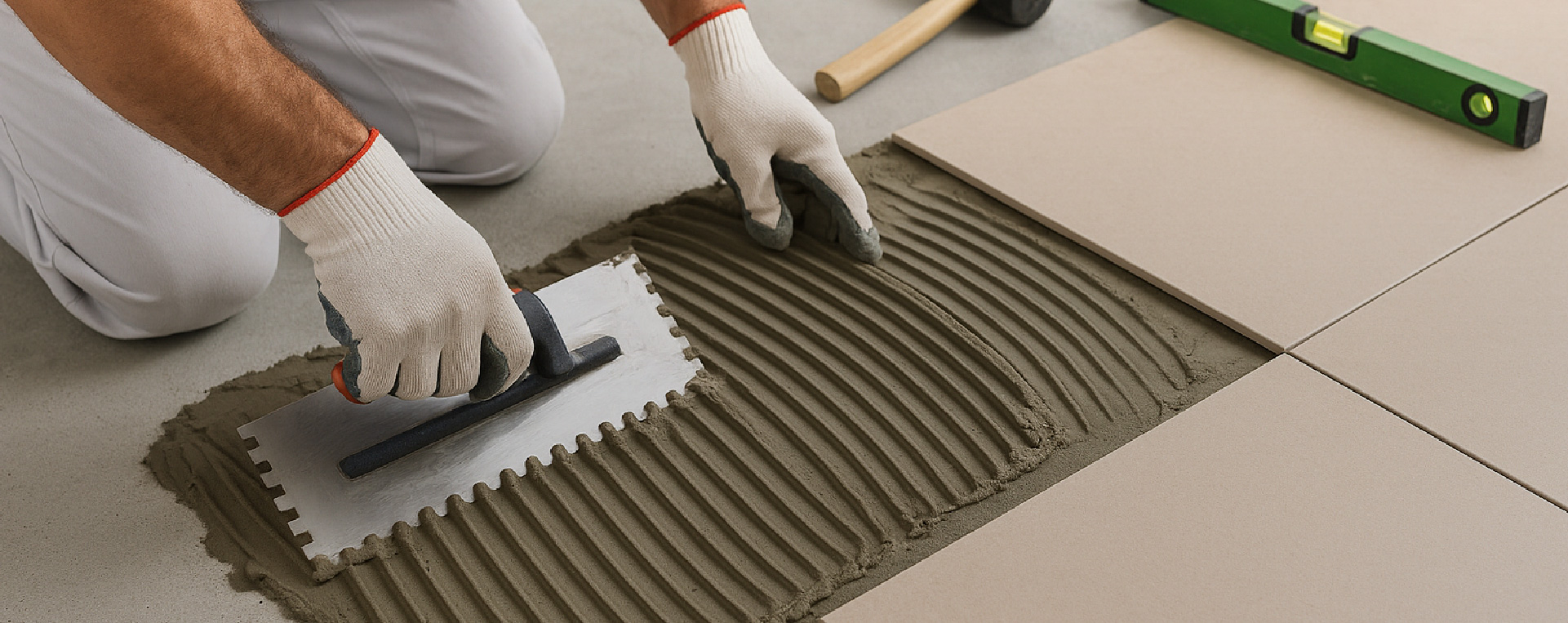
In India, tiles are a popular choice for floors and walls across homes, offices, and commercial spaces. Yet, despite their widespread use, many installations still rely on the traditional cement–sand mortar mix prepared on-site. According to industry insights, nearly 90–95% of tile installations in India continue to use this conventional method instead of advanced, ready-mix tile adhesives. While economical at first glance, this practice often leads to uneven application, weak bonding, and eventual tile detachment - problems that can compromise both appearance and durability.
Modern tile adhesives have emerged as a dependable solution to these long-standing issues. Unlike site-mixed mortar, these adhesives are scientifically formulated to provide uniform coverage, superior bonding, and resistance to moisture and temperature changes. However, with multiple adhesive types available today, selecting the right one for each surface and tile type is crucial to ensuring long-term performance.
Why the Right Adhesive Makes All the Difference?
Tiles vary in density, porosity, and weight - from lightweight ceramic to dense vitrified or natural stone. Similarly, surfaces differ in their texture and flexibility - concrete, plaster, gypsum boards, or existing tiles. Each of these combinations demands an adhesive with specific properties. Using a general-purpose or incorrect adhesive can result in hollow sounds, cracks, or even tiles lifting over time.
BirlaNu Tough Tile Adhesives are engineered to address these varied challenges. Formulated with advanced polymers and bonding agents, they ensure a strong, flexible, and durable hold across different substrates. By matching the right adhesive to the right surface, installers can achieve a finish that is not only visually seamless but also built to last.
Types of Adhesives & How They Fit Your Surface
Different tiling needs call for different adhesive formulations, each designed to perform best under specific site conditions.
- Standard cementitious adhesive: Best suited for indoor floors and walls with smaller ceramic or moderately porous tiles in dry conditions. A product like BirlaNu Tough Tile Adhesive - TA 105 offers dependable bonding strength and smooth workability for everyday tiling tasks.
- Flexible or polymer-modified adhesive: Where the surface is prone to slight movement - such as cement boards, plywood, or outdoor areas - flexibility becomes essential to prevent cracks and debonding. BirlaNu Tough Tile Adhesive like DSTA 605 or DSTA 610 provides added elasticity and are well-suited for both internal and external use.
- Water-resistant or waterproof adhesive: In moisture-prone spaces like bathrooms, kitchens, balconies, or terraces, a water-resistant adhesive is key to preventing seepage and maintaining long-term adhesion. BirlaNu Tough Tile Adhesive PUA 5000 delivers excellent performance in these wet-area applications.
- High-bond or heavy-duty adhesive: For large-format tiles, natural stones, or vertical installations that require higher tensile strength and longer open time, adhesives with superior bonding capability are ideal. Options such as BirlaNu’s STA 505 or STA 1000 offer the required hold and stability for heavy-duty tiling projects.
Conclusion: Protecting Your Tile Investment
Tiling is more than surface decoration - it’s a long-term investment in your space’s look and durability. Using the correct adhesive ensures that your tiles will remain firmly bonded, free from cracks, lifting or moisture damage. The BirlaNu Tough Tile Adhesive range gives you tailored solutions that match surface type, tile size and exposure conditions - so your tiled finish remains flawless for years to come.
The right tile adhesive protects both your investment and your peace of mind. Explore the
BirlaNu Tough Tile Adhesive range for solutions tailored to every tile type, surface, and environment, ensuring long-lasting, flawless finishes.
FAQs
Is tile adhesive better than cement mortar?
Yes, it offers better grip, faster installation, and a smoother, longer-lasting finish.
Why is choosing the right tile adhesive important?
It ensures strong bonding, prevents cracks or lifting, and keeps tiles looking flawless for years.
Can the same adhesive be used on all surfaces?
No. Different surfaces - like concrete, plywood, or old tiles - need adhesives with specific properties.
What type of adhesive is best for wet areas?
A waterproof or moisture-resistant adhesive works best in bathrooms, kitchens, and balconies.