Key takeaways
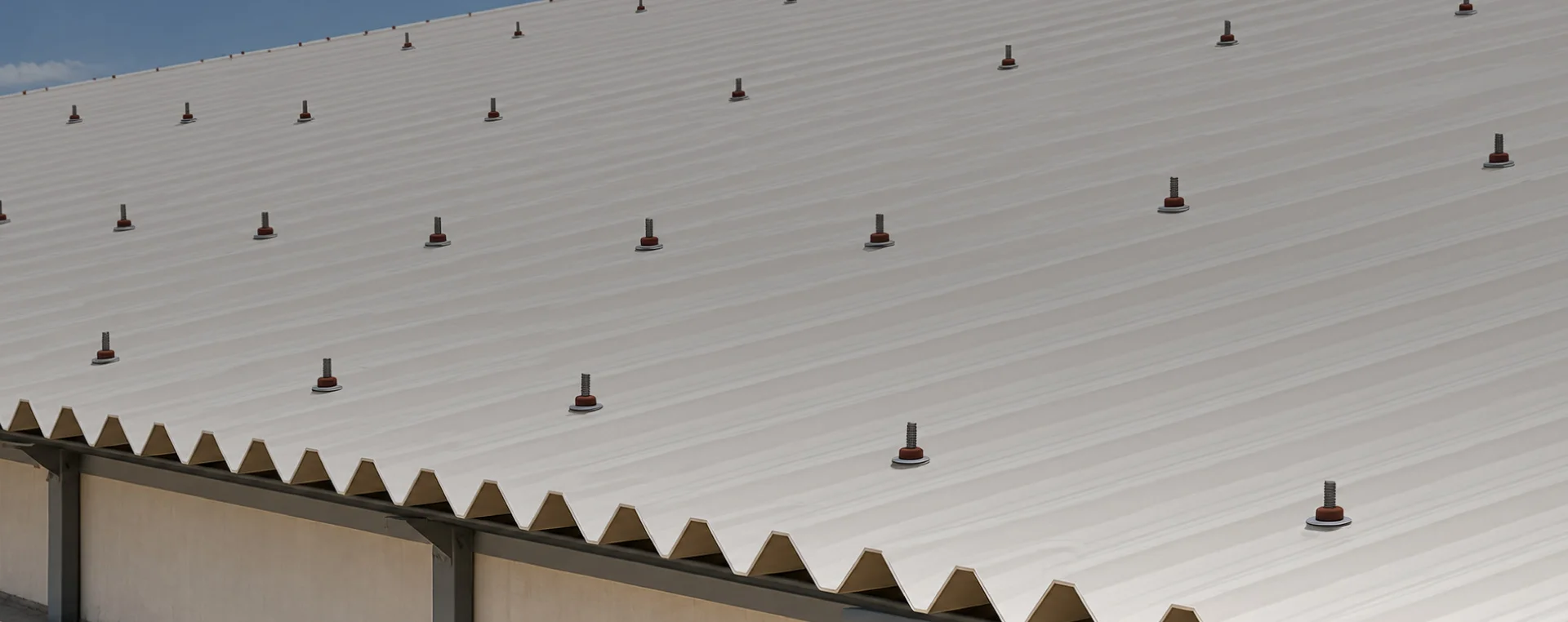
- Many roof leaks begin at fixing points rather than in the sheet itself, because every bolt hole is a potential entry for water.
- EPDM sealing washers form a watertight barrier around each fastener, but only when compressed correctly and used once.
- Bolts do two jobs: they hold sheets to the structure and help resist wind uplift.
- Drilled holes, crown fixing and correct tightening prevent most installation-related leaks.
- Charminar BirlaNu tools and accessories, including EPDM washers, J-bolts and L-bolts, are designed for leakproof sealing and structural support across Charminar roofs.
Introduction
A roof rarely fails all at once. More often, a damp patch appears near a purlin after the first heavy monsoon shower, and the search begins for a crack that does not exist. The sheet is sound. The problem is the small hole made to fix it in place.
Every bolt passes through the
cement roofing sheet, which means every bolt creates a gap. Whether that gap stays sealed for a season or for decades depends on two humble components: the bolt that anchors the sheet and the sealing washer that closes the opening around it.
Why fixing points are where roofs give way
Roofing sheets are built to shed water, so the sheet itself is seldom the weak link. Fixing points are different. Each one has to cope with rain, sun, thermal movement and wind at the same time, season after season. Metal roofing specialists repeatedly point to over-tightened screws, under-tightened screws and worn washers as leading causes of leaks around fasteners, and the same principle applies to any through-fixed roof.
Wind adds another test. Research on roof cladding in storms shows that failures often begin where the sheet meets its supporting structure, with the sheet pulling through the fastener. Corroded fasteners make this worse, particularly in coastal and cyclone-prone regions. In short, a roof is only as strong as its weakest connection.
What an EPDM sealing washer actually does
EPDM (ethylene propylene diene monomer) is a synthetic rubber valued for its resistance to UV radiation, ozone and weathering. It stays flexible across a wide temperature range, typically from around -40°C to well above 100°C, which suits a rooftop that swings from a cool monsoon night to a scorching afternoon. When the washer is compressed between the nut and the sheet, it fills the tiny gaps around the bolt and stops water travelling into the hole.
Two rules decide whether it works:
- Correct compression: Too loose and water creeps under the washer during wind-driven rain. Too tight and the rubber is crushed or split, which shortens its life from the first day.
- Single use: Once compressed, an EPDM washer loses its sealing ability. Replace it rather than reusing it.
Why bolts do more than hold the sheet
J-bolts and L-bolts hook or bend around the supporting purlin and rise through the sheet, clamping it firmly in place. They resist gravity, but also the upward suction that strong winds create over a roof. A loose bolt lets the sheet flutter, which gradually enlarges the hole and breaks the washer's seal.
Good fixing practice follows a few simple rules:
- Drill, never punch: Punched holes can crack fibre cement sheets.
- Fix through the crown: Place bolts on the crown of the corrugation, not in the valley where water flows.
- Leave room to move: A slightly oversized hole lets sheets expand and contract without stressing the fixing. BirlaNu recommends a hole at least 3 mm larger than the bolt diameter.
- Choose the right bolt: Length and type should suit the purlin, the sheet thickness and the washer and nut.
Common fixing mistakes that cause leaks
Most fixing-related leaks trace back to a short list of avoidable errors. Before a job is signed off, ask your contractor to confirm that none of these has crept in:
- Over-tightening: Crushes the washer and can crack the sheet.
- Under-tightening: Leaves the washer unseated, so water seeps in.
- Reused washers: A compressed washer no longer seals reliably.
- Tilted bolts: An angled bolt stops the washer from sitting flat.
- Poor-quality rubber: Cheaper compounds perish faster under sun and heat.
Each of these costs little to prevent at installation and a great deal to fix once the roof is in use.
Complete your roof with Charminar BirlaNu tools and accessories
A well-fixed roof needs components engineered to work together.
Charminar BirlaNu tools and accessories are designed to provide leakproof sealing and structural support from installation through long-term use, and they suit roofing support and finishing across all Charminar products. The range includes:
- EPDM washers (22 mm outer diameter): Heat-resistant sealing that creates a watertight barrier around fasteners.
- J-bolts and L-bolts (3 inch wide, 7 inch high): Structural anchoring that fixes round and square pipes to all types of roofing sheets.
- Weatherproof capping for ridges: Finishing protection where the roof is most exposed.
The accessories are listed to IS 14871:2000 and are designed to eliminate water infiltration, enhance roof lifespan and prevent roofs lifting during storms.
They pair naturally with the wider range of
Charminar BirlaNu roofs, from durable fibre cement roofs and eco-friendly Fortune roofs to Ultracool fibre cement roofs, which are designed to reduce indoor temperatures by up to 8°C*, and pre-painted Coloured Steel Roofs. Choosing matched accessories means the sheet, bolt and washer are specified as one dependable system.
Conclusion
A roof is a system, and its reliability depends on the smallest parts as much as the largest sheets. Sound bolts, correctly compressed EPDM washers and careful installation stop water where it is most likely to enter, while keeping sheets anchored when storms arrive. A little extra attention to fixings costs far less than repairing damp ceilings, corroded purlins or lifted sheets later.
If you are planning a new roof or maintaining an existing one, explore Charminar BirlaNu tools and accessories alongside the complete roofing range at birlanu.com/roofs.
FAQs
Why do roofs leak around bolts and screws?
Roofs leak around fasteners because each bolt hole is a potential entry point for water. Common causes include over-tightened or under-tightened bolts, tilted fixings, worn sealing washers and thermal movement that gradually enlarges the hole.
Can I reuse EPDM washers on my roof?
No. An EPDM washer loses much of its sealing ability once it has been compressed, so reusing it can cause leaks. Fit a new washer whenever a bolt is removed or refitted.
What is an EPDM washer and how does it prevent roof leaks?
An EPDM washer is a synthetic rubber seal fitted around a roof bolt or screw. When compressed against the sheet, it creates a watertight barrier that blocks water from entering the fixing hole and protects the roof from water damage.
What size hole should I drill for J-bolts and L-bolts?
Drill a hole at least 3 mm larger than the bolt diameter to allow proper alignment and tight installation. Holes should be drilled rather than punched and positioned on the crown of the corrugation, not in the valley.