

4 minutes read
In modern construction, speed and cost are no longer separate decisions - they’re deeply connected. A delay in timelines often leads to increased labour costs, while inefficient materials can slow down entire projects.
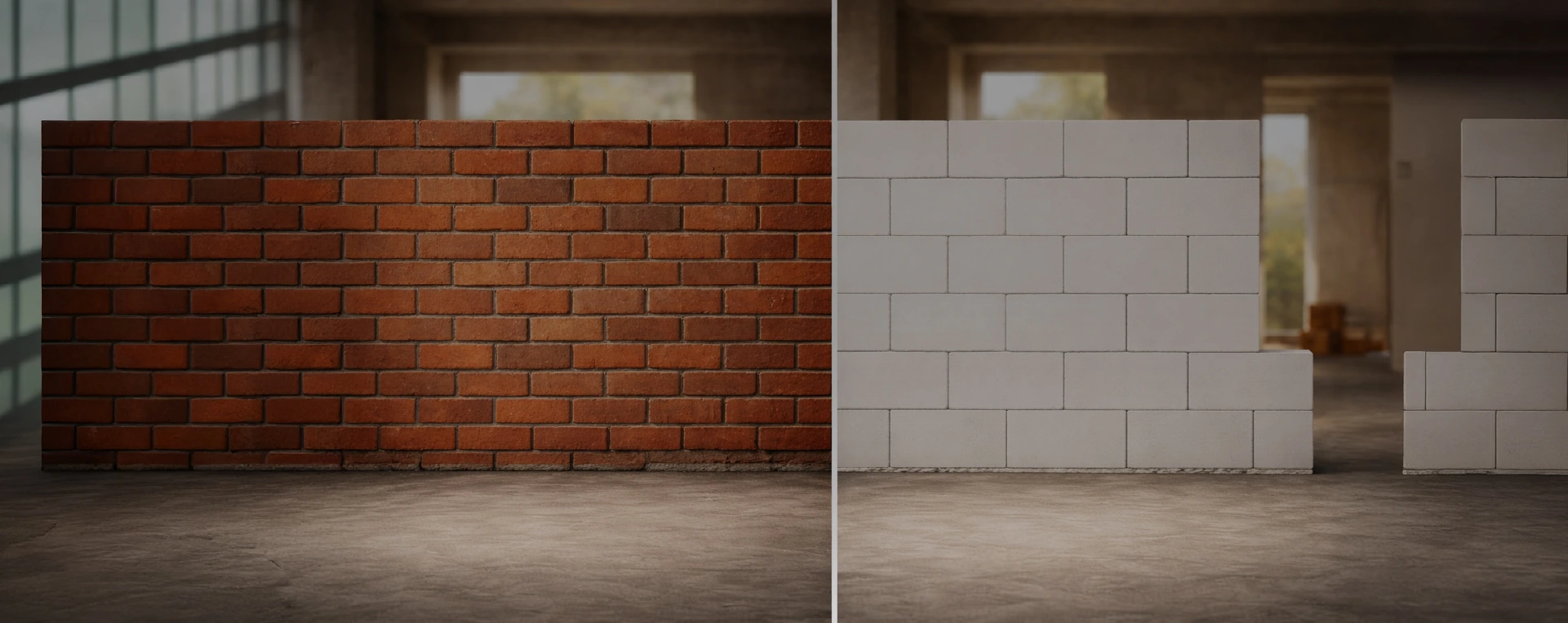
This is why the choice between AAC blocks and traditional red bricks has become more relevant than ever. Builders today aren’t just asking what works - they’re asking what works faster, better, and more economically over time.
AAC (Autoclaved Aerated Concrete) blocks are lightweight, precast building materials made from cement, lime, sand, water, and an expansion agent.
Key characteristics:
AAC blocks are widely used in modern construction for their efficiency and performance advantages.
Red bricks are traditional clay-based construction materials that have been used for decades.
Key characteristics:
Speed is one of the biggest differentiators on-site.
Verdict: AAC blocks enable faster construction and quicker project completion.
Material efficiency directly affects both cost and execution.
Verdict: AAC blocks reduce material consumption and labour intensity.
Cost isn’t just about material price - it’s about the total project expense.
Verdict: AAC blocks often deliver better overall cost savings at the project level.
The weight of materials impacts the entire building design.
Verdict: AAC blocks improve structural efficiency and design flexibility.
Energy efficiency is increasingly important in residential construction.
Verdict: AAC blocks contribute to better energy efficiency and indoor comfort.
Material quality plays a crucial role in achieving on-site efficiency. BirlaNu building solutions are designed to support modern construction needs by focusing on consistency, durability, and ease of application.
With a focus on high-performance materials, solutions aligned with AAC block construction help:
This ensures builders can maximise the inherent advantages of AAC blocks without compromising on quality.
Which is better for faster construction - AAC blocks or red bricks?
AAC blocks are better for faster construction because they are larger, lighter, and easier to install, reducing overall build time.
Do AAC blocks actually reduce overall construction cost?
Yes, despite a higher upfront cost, AAC blocks reduce expenses through lower labour, less mortar usage, and faster completion time.
What is the main difference between AAC blocks and red bricks?
AAC blocks are lightweight, uniform, and provide better insulation, while red bricks are heavier, less uniform, and require more labour for installation.
Are AAC blocks stronger than red bricks?
AAC blocks offer sufficient strength for most residential and commercial applications, along with added benefits like reduced structural load and better insulation.
Why are AAC blocks considered more efficient on-site?
Their larger size, uniformity, and reduced mortar requirement allow quicker installation and improved productivity on construction sites.
The latest

Standards, materials, range and supply: what to check before you buy
12/10/2026
10 minutes read

Why the smallest roofing components decide whether a roof stays dry, secure and durable for years.
12/10/2026
6 minutes read

Explore how different roofing materials perform across India’s heat, humidity and monsoons
11/10/2026
7 minutes read
Standards, materials, range and supply: what to check before you buy
- - 12/10/2026
Why the smallest roofing components decide whether a roof stays dry, secure and durable for years.
- - 12/10/2026
Explore how different roofing materials perform across India’s heat, humidity and monsoons
- - 11/10/2026
Choose the right pipes and fittings for reliable water supply and drainage.
- - 07/10/2026
