

7 minutes read
Key takeaways
When it comes to plumbing, water supply often gets all the attention, but drainage is just as important to get right. A poorly chosen drainage pipe can lead to blockages, leaks or even structural damage over time, and the cost of fixing a buried pipe is far higher than fixing one you can see.
Two terms that often come up in this space are SWR pipes and UGD pipes. Both are drainage solutions, and both are part of most plumbing projects, but they are built for different jobs. Understanding where each one fits will help you plan a drainage system that actually holds up over the years.
SWR stands for soil, waste and rainwater. As the name suggests, SWR pipes and fittings are designed to carry three types of discharge away from a building: waste from bathrooms and kitchens, soil discharge from toilets and rainwater from rooftops and terraces.
These pipes are generally used above ground or within the building structure itself, running along walls, through floors or down external faces of a building before connecting to the main drainage line. They are engineered for smooth, efficient flow rather than for bearing heavy external loads, which is what sets them apart from underground systems.
SWR pipes and fittings typically come in two types:
They are available in solvent-fit and push-fit joint options, which gives flexibility depending on the installation. A smooth inner bore keeps flow rates high and reduces the chances of blockages, while resistance to chemicals and corrosion means the pipes hold up well even when carrying wastewater with detergents or other household chemicals.
BirlaNu's SWR pipes and fittings are built with TruFiT Technology, which keeps every joint tightly aligned and leakproof, an important detail given how much these systems are relied upon daily inside a home or commercial building.
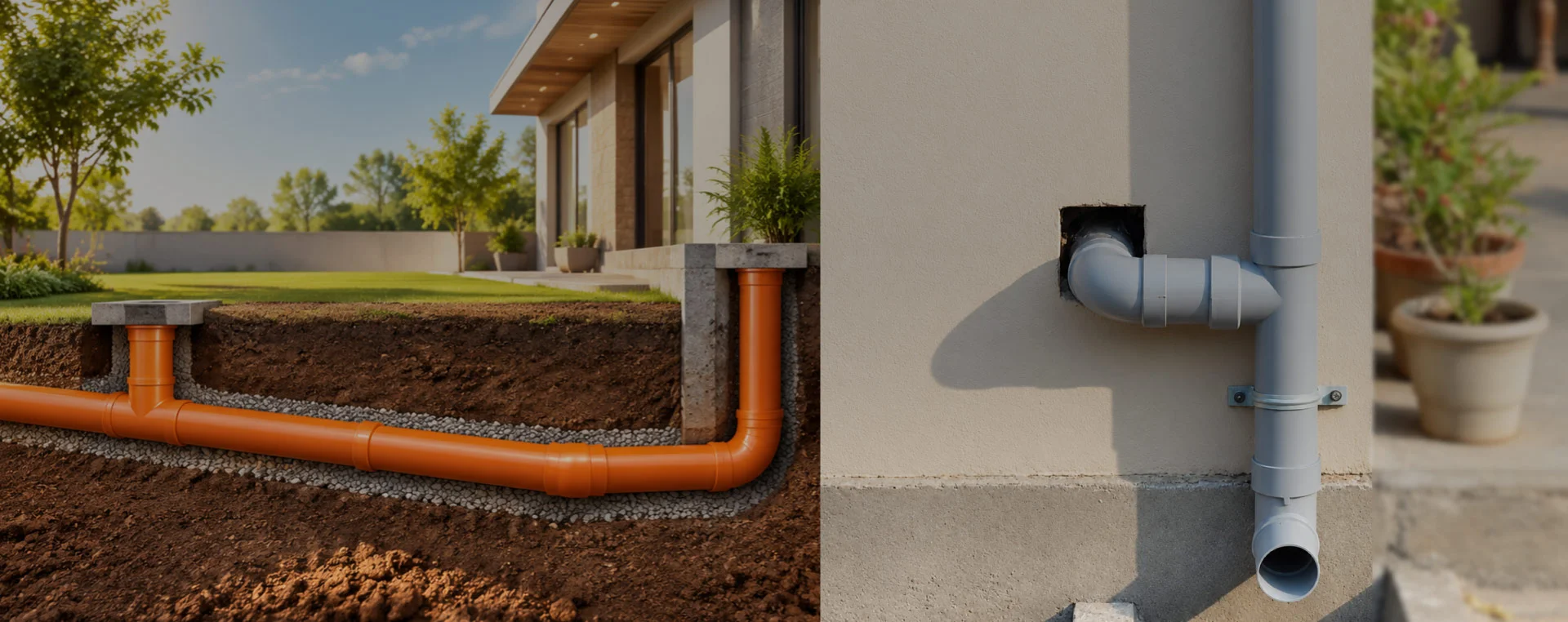
A UGD pipe, or underground drainage pipe, is built for an entirely different environment. Once wastewater leaves the building through the SWR system, it typically continues underground towards a municipal sewer line or a treatment system, and this is where underground drainage pipes take over.
Because a UGD pipe is buried, it needs to withstand something SWR pipe does not usually face: constant external pressure from the soil above it, along with the weight of vehicles, structures or landscaping that may sit over the buried line. This is why underground drainage pipes are rated by stiffness class, typically SN2, SN4 or SN8, depending on how much load-bearing capacity the installation requires.
Underground drainage systems also tend to be larger in diameter, since they often carry combined wastewater from multiple SWR lines within a building or even across several buildings. Depending on the product and site conditions, joints are made using either rubber ring push-fit connections or solvent cement, both designed to stay sealed under constant ground pressure and moisture.
Typical applications for a UGD pipe include:
|
Parameter |
SWR pipe |
UGD pipe |
|
Location |
Runs above ground or within the building |
Buried underground |
|
Load-bearing |
Not designed for soil pressure or external load |
Rated by stiffness class (SN2, SN4, SN8) for soil pressure and load |
|
Size range |
40 mm to 160 mm |
63 mm to 315 mm |
|
Joint type |
Sol-fit or push-fit |
Push-fit (rubber ring) or solvent cement, depending on stiffness class |
|
Standard |
IS 13592:2013 (pipes), IS 14735:1999 (fittings) |
IS 15328:2003 |
|
Purpose |
Manages soil, waste and rainwater discharge close to its source |
Carries discharge onward to municipal sewer or treatment systems |
Neither system replaces the other. A complete drainage plan for most buildings needs both, working together as one continuous path for wastewater.
In practice, this is rarely an either-or decision. If you are planning drainage for bathrooms, kitchens or rooftops within a building, you need SWR pipes and fittings. If that same wastewater, then needs to travel underground to a sewer connection or treatment point, you need a properly rated UGD pipe to carry it the rest of the way.
The real decision lies in getting the specifications right for each: the correct type and size for your SWR lines, and the correct stiffness class and diameter for your underground drainage, based on the depth of burial and the load it will face.
Drainage systems are difficult and costly to access once installed, so getting the specification right upfront matters more here than almost anywhere else in a plumbing project.
BirlaNu offers both SWR pipes and fittings and underground drainage pipes and fittings within one dependable range, which means your entire drainage path, from the fixture inside a building to the sewer line underground, can come from a single trusted source. Every product is engineered with TruFiT Technology for leakproof joints, along with strong resistance to chemicals and corrosion, so the system performs reliably whether it is running along a wall or buried several feet underground. You can explore the complete range at birlanu.com/pipes/plumbing-sanitation
Conclusion
SWR and underground drainage pipes are not competing options; they are two parts of the same journey that wastewater takes once it leaves a building. Getting both right, from the fittings inside your home to the pipe buried beneath the ground, is what keeps a drainage system working quietly for years without surprises. BirlaNu brings both ranges together with the same commitment to leakproof, durable engineering, so you can plan your entire drainage system from one place.
FAQs
What is the difference between an SWR pipe and a UGD pipe?
SWR pipes carry soil, waste and rainwater from fixtures and buildings, while UGD pipes are designed for buried drainage and sewerage applications where they face external soil and surface loads.
Why is pipe slope important in drainage systems?
Drainage pipes rely mainly on gravity flow, so the correct gradient helps wastewater move efficiently and reduces the risk of sediment build-up and blockages.
Does pipe diameter affect drainage performance?
Yes. The correct diameter depends on expected flow, number of connections, pipe gradient and system design. A larger pipe is not automatically the right choice.
Which pipe should I use for bathroom and toilet drainage?
SWR pipes are generally used for collecting soil and waste discharge from bathrooms and toilets before the flow enters the underground drainage network.
Why choose SWR and UGD pipes from the same manufacturer?
A coordinated system can simplify specification and installation while helping ensure compatibility between pipes and fittings across different sections of the drainage network.
The latest

What to consider before you choose, from moisture and footfall to pattern and light
23/10/2026
6 minutes read
How the right construction chemicals can prevent common building maintenance problems
22/10/2026
8 minutes read

Understand the key differences between fibre cement and coloured steel roofing sheets.
22/10/2026
7 minutes read
What to consider before you choose, from moisture and footfall to pattern and light
- - 23/10/2026
How the right construction chemicals can prevent common building maintenance problems
- - 22/10/2026
Understand the key differences between fibre cement and coloured steel roofing sheets.
- - 22/10/2026

Learn when waterproof putty is worth the upgrade for your walls
- - 19/10/2026
