Key takeaways:
• Charminar BirlaNu Roofs help keep farm structures cooler with high solar reflectance and improved thermal performance.
• Non-asbestos fibre cement construction offers a safer, durable roofing solution for farms and livestock sheds.
• Fibre cement roofs provide resistance to fire, termites, pests and corrosion, making them suitable for demanding farm environments.
• Their long service life and low maintenance can help reduce replacement and upkeep costs over time.
• Choosing the right sheet specification and ensuring proper installation are essential for long-term roofing performance.
If you run a farm, you already know that the roof over your poultry shed, dairy barn, or grain store does a lot more than keep the rain out. It sets the temperature your animals live in, decides how much noise reaches them, and determines how long you'll go before you're back up on a ladder replacing sheets. For a growing number of farm owners across India, the answer to all three problems has turned out to be the same material: fiber cement roofs.
Once seen as a purely industrial, no-frills option, fiber cement roofing sheets have quietly become one of the most practical upgrades a farm can make - not because they look impressive, but because they change the day-to-day economics of running livestock and storage operations. Here's what the shift is really about, and why "eco-friendly" isn't just a marketing label in this case.
What are fiber cement roofs, exactly?
Fiber cement roofs are made by combining high-grade cement with reinforcing fibers, in much the same way steel reinforces concrete. That fiber matrix is what gives the sheets their strength - allowing them to meet and often exceed Indian strength standards (IS 459:1992) while remaining light enough to install over large spans without heavy structural support.
Unlike older asbestos-based sheets, today's fiber cement roofing sheets use non-asbestos reinforcement, which removes the health and regulatory concerns that came with older-generation roofing. They're manufactured in a corrugated profile - the classic wavy pattern you'll recognize from sheds and warehouses across the country - which adds rigidity and helps with water runoff, an underrated feature during monsoon season.
Why farm owners are choosing eco-friendly fiber cement roofs
The clearest evidence for why fiber cement roofing works on farms doesn't come from a lab - it comes from the people using it every day.
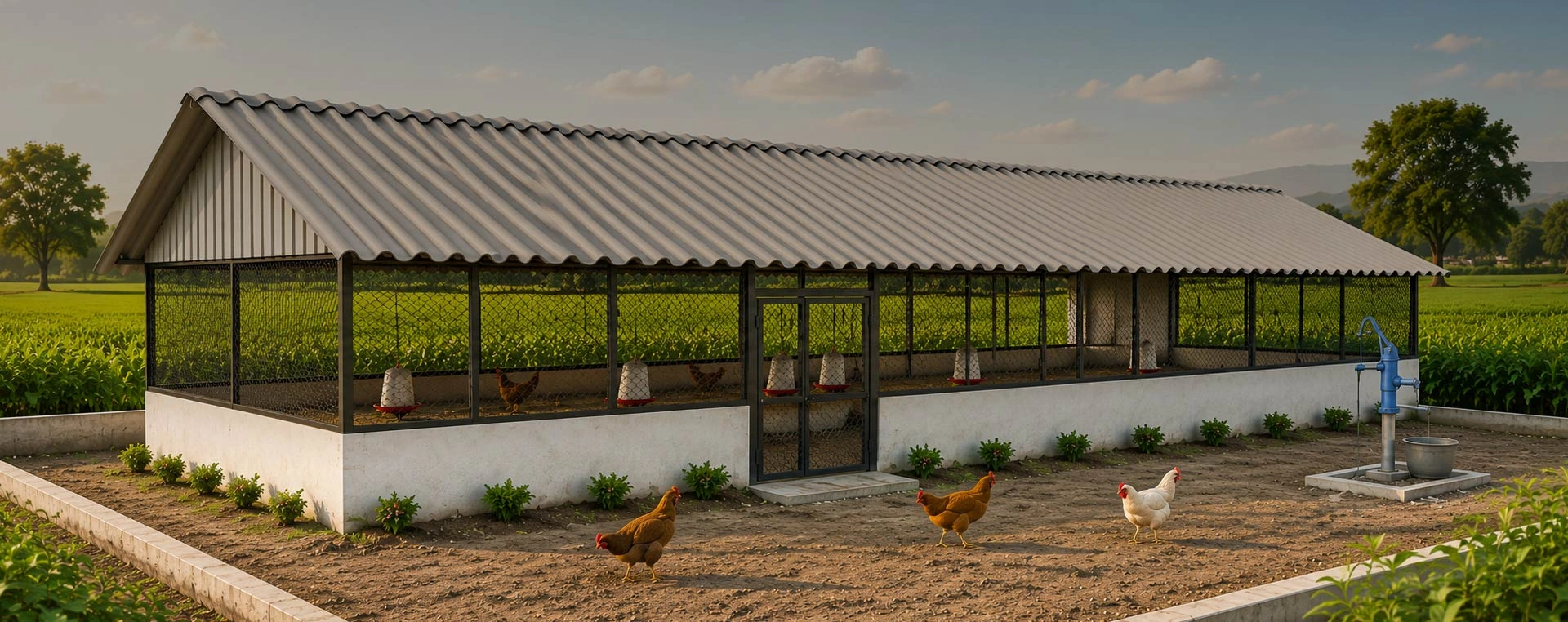
Take poultry farming, one of the most temperature-sensitive operations there is. Birds are highly vulnerable to heat stress, and a shed that traps heat can quietly push up mortality rates and slow growth without an obvious cause. Long-term poultry farm operators using fiber cement roofing have reported indoor temperature drops of 4–5°C compared to conventional roofing, along with a noticeable reduction in noise from the outside environment.
This thermal performance is a key feature of Charminar BirlaNu Roofs, engineered with high solar reflectance to help reduce heat absorption and keep spaces cooler. The roof can help lower indoor temperatures by up to 8°C compared to standard sheeting, making a meaningful difference in hot Indian conditions. For dairy cattle, poultry and other livestock housed under sheds, better temperature control can help reduce heat stress and support healthier, more productive conditions. This makes Charminar BirlaNu Roofs a practical roofing solution for agricultural and livestock applications, where managing heat is essential for both animal well-being and operational efficiency.
What actually makes eco-friendly roofing sheets "eco-friendly"
It's worth being specific here, because "eco-friendly" gets used loosely in construction marketing. For fiber cement roofing sheets, the claim rests on a few concrete points:
• Natural, non-toxic composition. Charminar BirlaNu's sheets are made primarily from cement, water, and reinforcing fibers - with no asbestos and no coatings that release toxic fumes when heated, which matters both for farm workers and for animals housed underneath.
• Reduced energy demand. Roofs are responsible for roughly 10–15% of a building's total heat gain or loss. A roofing material that reflects rather than absorbs heat cuts down the need for mechanical cooling or ventilation, which is a real energy saving on farms running fans or coolers through summer.
• Long service life, less waste. A roof that lasts several decades - some fiber cement installations are rated for 40+ years with proper installation - means fewer replacement cycles and less material sent to landfill over the building's lifetime, compared to roofing that needs replacing every 10–15 years.
• Alignment with green building standards. India's green building frameworks, including GRIHA and IGBC, increasingly recognize reflective, durable, low-toxicity roofing as part of sustainable construction - relevant if you're building a new agricultural structure with any eye toward certification or subsidy eligibility.
Put together, these are the reasons eco-friendly fiber cement roofs are being treated as a genuine sustainability upgrade, not just a durability one.
Beyond livestock: grain stores, warehouses, and equipment sheds
Farms rarely run on just one structure, and fiber cement roofing earns its keep across all of them:
• Grain and feed storage benefits from the same temperature regulation that helps livestock - stable, cooler conditions slow spoilage and reduce pest activity.
• Fire resistance is a genuine safety advantage for any structure storing dry feed, hay, or equipment, where a spark or electrical fault could otherwise be catastrophic.
• Corrosion resistance means the sheets hold up in humid, coastal, or heavily irrigated regions where metal roofing would rust within a few seasons.
• Termite and pest resistance protects the structural integrity of the roof itself - unlike wood or some composite materials, there's nothing for termites to feed on.
For equipment sheds and workshops, this combination of resistance to fire, rust, and pests adds up to fewer unplanned repairs and a roof you can genuinely forget about for years at a time.
The long-term value argument
Farm infrastructure decisions are usually made in decades, not seasons, and this is where fiber cement roofs make their strongest case. The upfront cost is comparable to, or lower than, many metal roofing options, but the combination of a multi-decade lifespan, low maintenance, and reduced cooling costs means the total cost of ownership tends to come out well ahead over 15–20 years. Fewer sheet replacements, fewer repair callouts, and lower energy bills for climate control all compound over time - which is exactly the kind of return farm owners are usually optimizing for.
Choosing the right eco-friendly fiber cement roofing sheet for your farm
Charminar BirlaNu's fiber cement roofing range for agricultural use is built around exactly these considerations. A few practical factors are worth weighing before you buy:
1. Sheet thickness and profile: thicker sheets and deeper corrugation generally mean better load-bearing capacity and durability for larger spans like barns and warehouses.
2. Color and coating: lighter colors and reflective coatings improve solar reflectance and cooling performance, which is especially valuable for poultry and dairy sheds.
3. Correct installation: proper slope, overlap, and fixing accessories matter as much as the sheet itself. Even the best eco-friendly roofing sheets will underperform if installed with insufficient overlap or the wrong slope, so it's worth using trained installers rather than cutting corners here.
4. Application fit: residential farmhouses, poultry sheds, warehouses, and industrial structures all have slightly different load, span, and ventilation needs, so it's worth matching the sheet specification to the specific structure rather than buying one standard option for the whole farm.
Conclusion
Fiber cement roofs have moved well past their old reputation as a purely utilitarian, low-cost option. For farm owners, the combination of thermal performance, non-toxic composition, pest and fire resistance, and multi-decade durability makes eco-friendly fiber cement roofs one of the more quietly impactful decisions you can make for a livestock operation, storage facility, or farm building. The payoff shows up in fewer sick or stressed animals, lower energy bills, and a roof you won't have to think about again for a very long time.
If you're planning a new shed, barn, or storage structure - or replacing an aging roof - it's worth looking at eco-friendly roofing sheets not as a premium add-on, but as infrastructure that pays for itself in reduced losses and lower running costs year after year. Charminar BirlaNu's fiber cement roofing range is built specifically for these use cases - explore our farm and agricultural roofing solutions to find the right fit for your structure.
FAQs
Why are Charminar BirlaNu Roofs suitable for farms?
Charminar BirlaNu Roofs are designed to offer thermal performance, durability and resistance to fire, pests and corrosion, making them suitable for poultry sheds, dairy barns, warehouses and other farm buildings.
Can fibre cement roofs help keep farm sheds cooler?
Yes. Charminar BirlaNu Roofs are engineered with high solar reflectance to reduce heat absorption and can help lower indoor temperatures by up to 8°C compared with standard sheeting, depending on site and installation conditions.
Can fibre cement roofs help keep farm sheds cooler?
Yes. Charminar BirlaNu Roofs are engineered with high solar reflectance to reduce heat absorption and can help lower indoor temperatures by up to 8°C compared with standard sheeting, depending on site and installation conditions.
Can these roofs be used in coastal or humid areas?
Fibre cement sheets offer good resistance to corrosion, making them a practical option in humid and coastal environments where conventional metal roofing may be more prone to rust.