Key takeaways
- Structural walls and non-load-bearing applications should not be approached in the same way.
- Brick and mortar may be unnecessary for several internal divisions and design applications.
- Fiber cement boards can be used for partitions, false ceilings, fixed furniture and customised design elements.
- Cement boards can receive finishes such as paint, tiles, wallpaper and laminates.
- Designer boards can bring texture to ceilings, interior surfaces and exterior cladding.
- Correct framing, fixing, joint treatment and finishing are essential for lasting performance.
A family renovating its home decides to create a separate study, redesign the ceiling, add built-in storage and introduce a textured feature wall. The initial plan includes brickwork for the study, plaster of Paris for the ceiling, plywood for the storage unit and additional decorative layers for the feature wall.
Each solution may work individually. Together, however, they can introduce more wet work, curing, surface preparation, material handling and coordination than the project actually requires.
This is a common construction oversight. Brick and mortar remain essential for structural walls and permanent masonry. However, not every enclosure, ceiling or design surface needs to follow the same construction process.
By first understanding what a space requires, homeowners and professionals can identify where conventional construction is necessary and where materials such as fiber cement board can offer a more efficient and versatile solution.
Start with the purpose of the wall
One of the most important decisions in wall construction is determining what the wall is expected to do.
A structural wall carries loads and must follow approved architectural and engineering specifications. An external wall may need protection from weather while an internal wall may simply divide two rooms, conceal services or improve privacy.
Problems arise when the same heavy construction method is used for every requirement.
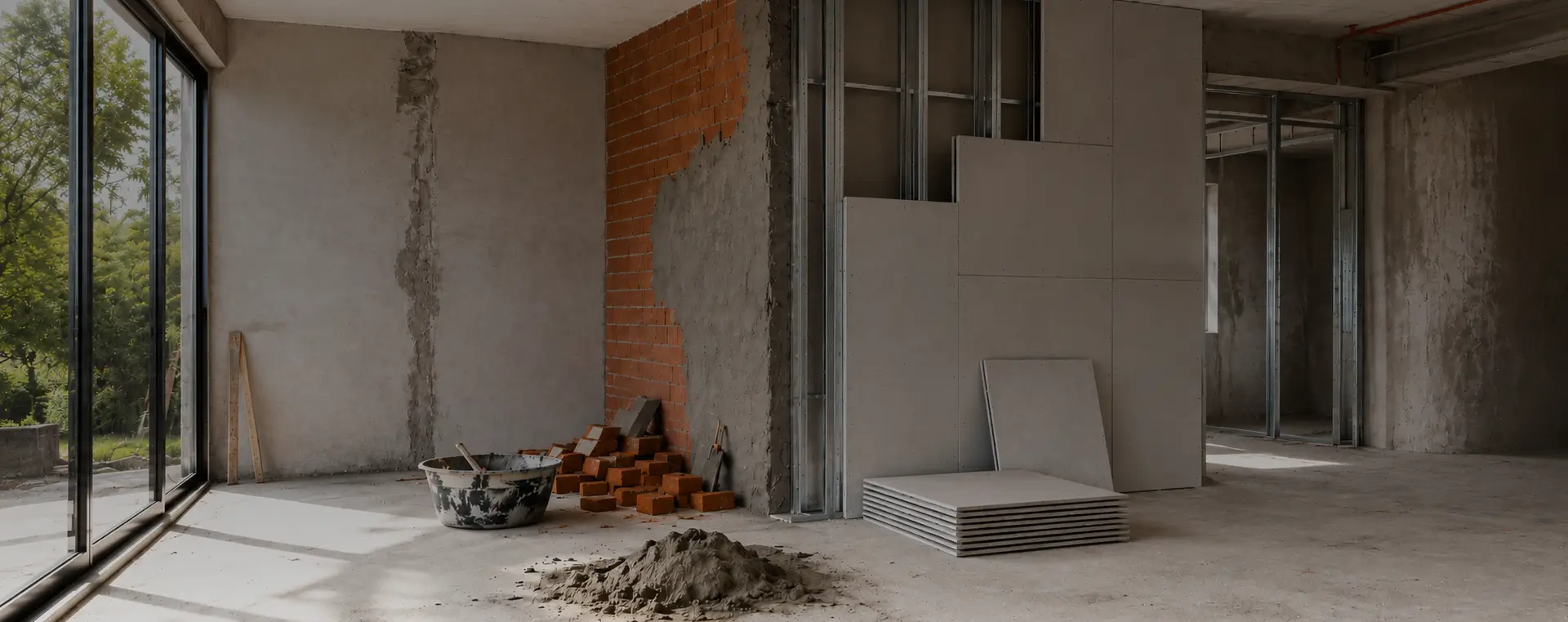
For example, creating a small study, utility area, office cabin or changing room may not always require a complete brick wall. Where the application is non-load-bearing, a framed system using fiber cement boards can help create the required enclosure without the multiple wet stages associated with conventional masonry.
BirlaNu Aerocon Fiber Cement Boards are designed for applications including partitions and are available in different thicknesses to suit varied construction and design requirements. They are factory-cured, which means no on-site water curing is required before installation.
Look beyond space division
Fiber cement boards are often associated only with partition walls. This limits their role to one small part of the construction process.
In practice, modern homes, offices and commercial spaces require materials that can support multiple applications. Apart from creating internal divisions, cement boards can also be considered for false ceilings, fixed furniture and computer numerical control or CNC-cut design elements.
BirlaNu lists partitions, false ceilings, fixed furniture and CNC cutting among the primary applications of its Aerocon Fiber Cement Boards.
This versatility allows architects and homeowners to plan different elements of a space using a common material system. A study partition, overhead ceiling and built-in storage unit, for example, can be designed together instead of being treated as completely separate construction activities.
The objective is not to force one product into every application. It is to identify areas where a board-based solution can reduce unnecessary masonry, plastering or dependence on wood.
Plan services before completing the surface
Electrical wiring, lighting, plumbing lines, air-conditioning services and internet cables are often planned after the wall or ceiling has already been constructed.
This leads to cutting, chasing and repairing finished surfaces. Apart from creating additional work, repeated alterations can affect alignment and leave visible repair marks.
A framed board system offers space for planning concealed services within the assembly. Electrical points and cable routes can be considered before the final board is fixed, making the installation cleaner and more organised.
The same approach is useful for false ceilings. Lighting fixtures, ducts and access points can be positioned before the finished ceiling surface is completed.
However, the service plan must be finalised early. Even a flexible material system cannot compensate for poor coordination between the construction, electrical and interior teams.
Choose ceiling materials for performance as well as appearance
False ceilings are usually selected according to their design, but they also perform several functional roles. They conceal services, support lighting layouts and help create a more finished interior.
The selected material should therefore be considered according to the conditions of the room, not only its appearance.
Fiber cement boards can be used for false ceiling applications where a stable cement-based surface is required. Their dimensional stability and resistance to moisture make them relevant for different interior environments when installed, sealed and finished correctly. BirlaNu also identifies sound insulation and thermal conductivity among the performance features of its Aerocon Fiber Cement Boards.
The framework, board thickness and placement of access panels should be planned according to the complete ceiling system.
Rethink the materials used for fixed furniture
Plywood and wood-based materials are commonly selected for cabinets, shelves and built-in storage. However, the suitability of any furniture material depends on its location, expected use and exposure conditions.
For selected fixed furniture applications, fiber cement board can offer another option. BirlaNu Aerocon Fiber Cement Boards are positioned as an alternative to wood for construction and design applications, with fixed furniture included among their recommended uses.
The boards can be finished with paint, laminates, wallpaper or tiles, allowing the visible surface to match the wider interior design.
This can be useful for permanently installed storage, utility units and integrated furniture elements. The supporting framework must still be designed for the intended load, especially where shelves, appliances or heavy fixtures will be placed.
Introduce texture without unnecessary surface layers
Some spaces require more than a plain painted wall. Living areas, reception spaces, office entrances, retail environments and building exteriors may need texture and visual depth.
Rather than constructing a basic surface and then adding multiple decorative treatments, pre-textured designer cement boards can bring performance and aesthetics together.
BirlaNu Aerocon Fiber Designer Boards are engineered for interior and exterior applications. They feature a natural grainy texture and are available in designer finishes for ceilings, cladding, fences and other surface applications.
Their listed features include termite resistance, dimensional stability, design-led finishes and wood-like appearance.
This makes Designer Boards relevant where a project requires the visual character of a finished surface along with the durability of a cement-based material.
Understand what moisture resistance means
Moisture can affect walls, ceilings and fixed furniture, particularly in kitchens, utility spaces, bathrooms and areas exposed to changing weather conditions.
BirlaNu Aerocon Fiber Cement Boards are highly resistant to moisture and can be used in humid or wet areas when properly sealed and finished.
However, moisture resistance should not be confused with complete waterproofing. The performance of the finished installation also depends on:
Properly treated joints and edges
Compatible sealants and surface coatings
Protection around service penetrations
Suitable waterproofing in direct water-contact areas
Correct exterior detailing and drainage
Selecting a moisture-resistant board without completing the required sealing and waterproofing system can leave the installation vulnerable.
Making a smarter material choice
Avoiding wall construction mistakes does not mean replacing every brick wall with a board.
Brickwork, blocks and engineered walling systems remain necessary for structural walls, external enclosures and other permanent applications. Fiber cement boards serve a different purpose.
They become relevant where the project requires:
Non-load-bearing space divisions
False ceilings
Concealed services
Fixed furniture
Customised decorative elements
Finished interior surfaces
Textured ceilings or exterior cladding
The BirlaNu Aerocon Boards range includes Fiber Cement Boards for versatile construction and design applications as well as Designer Boards for textured interior and exterior surfaces.
Choosing between conventional construction and a board-based system should depend on what the application needs rather than what has traditionally been used.
Conclusion
Many common wall construction mistakes begin with selecting a material before understanding the purpose of the space.
Brick and mortar remain fundamental to construction, but they may introduce unnecessary wet work and additional processes when the requirement is a non-load-bearing partition, false ceiling, fixed furniture element or decorative surface.
In these applications, fiber cement board solutions can provide greater flexibility across construction and interior design. BirlaNu Aerocon Fiber Cement Boards can support partitions, ceilings, furniture and customised designs while Aerocon Designer Boards can add texture to interior and exterior surfaces.
The right approach is not to choose between traditional and modern materials universally. It is to use each material where its properties and applications make the most sense.
FAQs
What are fiber cement boards used for?
Fiber cement boards are used for applications such as non-load-bearing partitions, false ceilings, fixed furniture and CNC-cut design elements. They can also receive finishes including paint, tiles, wallpaper and laminates.
Can cement boards be used instead of brick walls?
Cement boards can be used for suitable non-load-bearing partitions and internal space divisions. They should not be treated as replacements for structural or load-bearing brick walls unless the complete system has been designed and approved by a qualified professional.
Can fiber cement boards be used for false ceilings?
Yes. Fiber cement boards can be used for false ceilings when installed over a properly designed framework. The board thickness, frame spacing and provision for lighting or concealed services should be planned before installation.
Can cement boards be used for furniture?
Cement boards can be used for selected fixed furniture applications such as built-in storage and utility units. A suitable supporting frame and additional reinforcement should be provided according to the load the furniture will carry.
What are designer cement boards used for?
Designer cement boards are used to introduce texture and visual character to ceilings, interior surfaces, cladding, fences and exterior applications. They can reduce the need to add separate decorative layers over a plain surface.
Are fiber cement boards waterproof?
Fiber cement boards are moisture-resistant but should not automatically be considered waterproof. Humid, wet and exterior applications require correct sealing, joint treatment and an appropriate waterproofing or protective system.