Key takeaways
- Multi-storey buildings require plumbing systems designed around pressure, flow, temperature and building height.
- Different applications may require different pipe materials rather than one pipe type throughout the building.
- Pipe diameter and pressure rating should be selected based on actual system requirements rather than appearance or cost alone.
- The quality and compatibility of pipes and fittings are just as important as the pipe itself.
- Correct installation, jointing, support and testing are essential for long-term plumbing performance.
- Choosing a complete plumbing system from a reliable manufacturer can simplify installation and reduce the risk of leakage and maintenance issues.
Behind the elegantly finished walls of any modern high-rise lies a complex, constantly working network that brings the building to life. A multi-storey building puts vastly different demands on a plumbing system compared to a standard independent house.
A multi-storey building puts vastly different demands on a plumbing system compared to a standard independent house. Water has to fight gravity to travel across several floors, maintain adequate pressure, handle varying temperatures and perform flawlessly long after the walls and ceilings are permanently sealed. Even a microscopic weakness in a joint or an unsuitable pipe can eventually result in silent leakage, spreading dampness, massive water wastage and incredibly disruptive repairs.
That is why choosing a plumbing pipe should never be treated as a simple material-selection exercise. To protect a building from the inside out, the pipe material, pressure rating, diameter, jointing method and the quality of the accompanying pipes and fittings must all work together as one unified, fail-proof system.
Why plumbing pipe selection matters more in multi-storey buildings
The higher a building rises, the more complex its water distribution becomes. Water supplied from a tank, pump or other source has to travel through vertical risers and horizontal branches before reaching individual fixtures. This creates changes in pressure across different floors.
Lower floors can experience higher static pressure while upper floors may need additional pressure to maintain adequate flow. In larger buildings, engineers may therefore divide the plumbing network into pressure zones and use appropriate control equipment to maintain safe and usable pressure.
The choice of plumbing pipe must take this operating environment into account. Selecting a product simply because it worked well in a low-rise house may not be sufficient for a taller building.
Start with the application, not the material
There is no single pipe material that is ideal for every plumbing application. A multi-storey building normally has several water and drainage requirements, including cold water supply, hot water distribution, soil and waste discharge, rainwater drainage and sometimes specialised systems. The important point is to match the pipe to the job instead of trying to use the same product everywhere.
For example:
uPVC pipes: Commonly suited to cold-water plumbing applications.
CPVC: Designed for hot and cold potable water systems.
PPR: Can be used for hot and cold-water applications and is also relevant to HVAC and other specialised systems.
Drainage applications: Require suitable SWR, underground drainage or other purpose-specific systems.
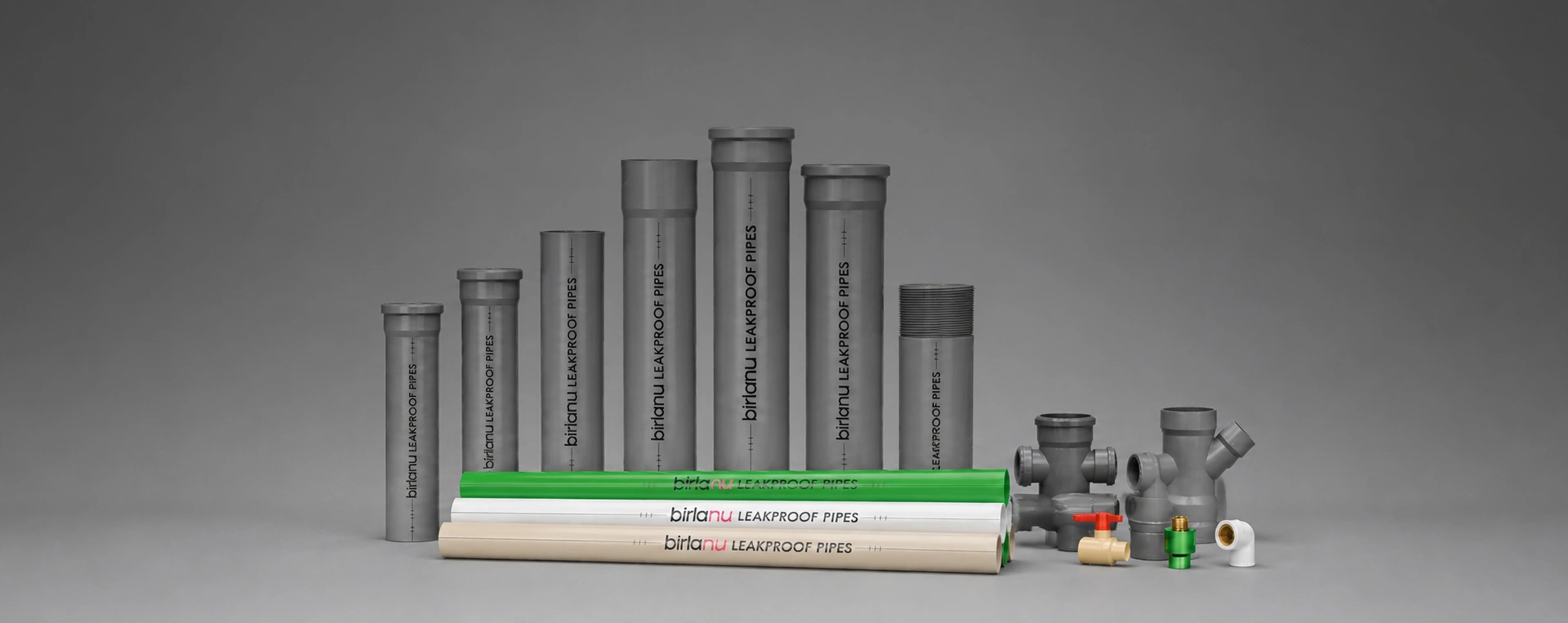
BirlaNu's portfolio: Reflects this application-based approach, with CPVC, uPVC, PPR, SWR, Silent, underground drainage and other pipe systems available for different requirements.
Consider pressure and building height
Pressure is one of the most important factors when selecting plumbing systems for multi-storey buildings. Every additional floor adds vertical height to the water column. Pumping systems can further increase operating pressure, particularly in lower zones. The pipe selected must therefore have an appropriate pressure rating for the conditions in which it will operate.
- Design considerations: The designer should consider static pressure, pump pressure, pressure fluctuations and the possibility of water hammer.
- Pressure zoning: This is also why pressure zoning can become important in taller buildings. Instead of supplying every floor at the same pressure, the system can be designed into zones with appropriate pressure management.
- Selection criteria: Do not select a pipe based only on its nominal diameter. Check its pressure class, operating temperature and application suitability against the project's design requirements.
Choose the right diameter for the required flow
Pipe diameter affects both water flow and pressure loss. A pipe that is too small can restrict flow and cause poor performance when several fixtures are being used at the same time. Oversizing every line, however, can increase material costs and may not provide an efficient system.
- Hydraulic calculations: The right diameter should be determined through proper hydraulic calculations.
- Influencing factors: Factors such as the number of fixtures, simultaneous demand, pipe length, vertical height, bends and fittings all influence the final selection.
- Homeowner considerations: For a homeowner, this is one area where relying solely on the plumber's preference may not be enough.
- Project review: For larger projects, the plumbing design should be reviewed by the relevant engineering or MEP team before procurement.
Do not overlook pipes and fittings
A plumbing system is only as reliable as its weakest connection. Choosing a high-quality pipe but pairing it with incompatible, poorly manufactured or incorrectly installed fittings can undermine the entire system.
- Component compatibility: The elbows, tees, couplers, reducers, unions and other components should be compatible with the selected pipe and its jointing method.
- Pipe fitting accessories: The same principle applies to pipe fitting accessories, including the relevant solvent cement, primers, clamps, supports and other installation components.
- BirlaNu's plumbing range: For example, BirlaNu's plumbing range combines pipes with engineered fittings and solvents. Its TruFiT Technology is designed around dimensional precision between pipes and fittings to support accurate alignment and leakproof joints.
- System approach: This system approach is particularly useful in multi-storey construction, where the number of joints increases significantly as the plumbing network becomes larger.
Think about hot and cold water separately
Temperature is another factor that should influence pipe selection. A pipe suitable for cold-water distribution should not automatically be assumed to be suitable for hot water.
- CPVC applications: CPVC is specifically designed for hot and cold potable water applications. BirlaNu CPVC Pipes and Fittings, for instance, are manufactured for hot and cold-water management and comply with IS 15778:2007.
- PPR applications: PPR is another option for hot and cold-water systems. BirlaNu PPR Pipes and Fittings are designed for applications including plumbing, HVAC and solar water heating systems.
- Making the choice: The correct choice ultimately depends on the project's design conditions, temperature requirements, pressure and applicable specifications.
Pay attention to drainage and plumbing noise
Water supply is only one part of a building's plumbing network. Drainage pipes carry wastewater away from bathrooms, kitchens and other areas. In multi-storey buildings, vertical drainage stacks can also transmit considerable noise through walls and service shafts.
- Occupant sensitivity: This becomes particularly relevant in apartments, hotels, hospitals and premium residential buildings where occupants may be sensitive to the sound of water discharge.
- Silent drainage systems: A purpose-designed silent drainage system can help address this issue. BirlaNu Silent Pipes use a three-layer construction with a mineralised middle layer intended to provide noise insulation. The range is designed for applications including high-rise residences, hotels, hospitals and commercial buildings.
- Underground drainage: Similarly, underground drainage systems need to be selected according to the expected loading and installation conditions. BirlaNu's underground drainage range is available in stiffness classes including SN2, SN4 and SN8 for different load-bearing requirements.
Installation matters as much as selection
Even a well-designed plumbing system can develop problems if installation is poor.
- Proper preparation: Pipes should be cut correctly; joints should be prepared according to the manufacturer's instructions and the correct pipe fitting accessories should be used.
- Supports and alignment: Adequate supports and clamps are also important, particularly on vertical risers and long horizontal runs. Pipes should have sufficient allowance for movement where required and should not be forced into alignment during installation.
- Inspection and testing: Once installation is complete, the system should be inspected and pressure tested as specified before pipes are concealed behind walls, floors or ceilings. Finding a problem before finishing work is considerably easier than repairing a concealed leak later.
Common mistakes to avoid
One of the most common mistakes is choosing pipes primarily on upfront price.
- Long-term costs: A cheaper product may appear attractive during construction but can become expensive if it leads to frequent repairs or premature replacement.
- Installation errors: Other mistakes include using one pipe type for every application, ignoring pressure requirements, mixing incompatible components, using poor-quality fittings and skipping testing before concealing the installation.
- Future maintenance: Another often-overlooked issue is future maintenance. Service shafts, valves and critical joints should remain reasonably accessible so that maintenance does not require unnecessary demolition.
Conclusion
Choosing the right plumbing pipe for a multi-storey building requires more than comparing prices or selecting the most familiar material. Pressure, temperature, flow requirements, building height, application, drainage needs and installation conditions all need to be considered.
Equally important is the relationship between pipes, fittings and installation accessories. A well-matched system with compatible components and correctly executed joints can help reduce the risk of leakage and improve long-term reliability.
Whether you are building a new home, renovating an existing property or planning a larger residential or commercial project, taking the time to evaluate the complete plumbing system can prevent problems that are difficult and expensive to fix later. Solutions such as BirlaNu Leakproof Pipes demonstrate how a system-led approach, supported by precision-engineered joints and application-specific pipe options, can help make modern plumbing more dependable.
FAQs
Which plumbing pipe is best for a multi-storey building?
There is no single best pipe for every application. The right choice depends on whether the pipe is being used for hot water, cold water, drainage or another purpose, along with pressure, temperature and design requirements.
How does building height affect plumbing pipe selection?
Building height affects the pressure within the water distribution system. Taller buildings may require pressure zoning and appropriate pressure-rated pipes and fittings to ensure safe and consistent performance across different floors.
Why should plumbing pipes be pressure-tested before walls are closed?
Pressure testing helps identify leaks or weak joints while the plumbing remains accessible. Detecting a problem before concealing pipes can avoid costly repairs to finished walls, floors and ceilings.
Is CPVC suitable for multi-storey buildings?
CPVC can be used for hot and cold potable water applications when the product is correctly specified for the project's pressure, temperature and installation requirements. BirlaNu CPVC Pipes and Fittings are designed for hot and cold potable water management.